Personal site toolset review - Cursor, Lovable, Webflow and Ghost comparison
How three quick pivots (and ChatGPT) got two websites live
Product operations isn't just for SaaS roadmaps - it's the mindset I bring to every side project: define a goal, ship the smallest thing that proves it, measure, then iterate. Over the past month I built two personal websites and lived that loop in miniature. Here's the blow-by-blow, every pivot included.
Project 1 – A New Portfolio for Julia Pryjma
Context: Julia's current site, juliabujak.pl, runs on Hostinger. It looks fine but fights back whenever we try to bolt on custom analytics or marketing integrations-exactly the plumbing a modern photography business needs. Time for a rebuild.
Stage 1 – Lovable (the "let's-just-ship-something" phase)
Goal: Launch a cleaner portfolio tonight.
Tool picked: Lovable-a no-code site builder I'd been meaning to test.
Why Lovable?
- Super-fast visual editor.
- Promised responsive templates that scream "creative professional."
Twist #1 – Missing CMS
Within an hour Julia had a slick landing page, but the moment we talked about adding albums regularly, the deal-breaker surfaced: Lovable ships static sites only-no CMS. Uploading new galleries would mean cloning pages or editing JSON. Not scalable.
Stage 2 – Cursor (the "surely I can hack a CMS on top" phase)
Goal: Keep Lovable's look, bolt on content management.
Approach: Push Lovable's export to GitHub, then layer Cursor (a lightweight headless CMS) with Vercel for publishing and Supabase for storing on top.
Why Cursor?
- Natural language-first, Git-based workflow.
- Ability to tweak code on specific need.
- Free tier perfect for experiments.
Twist #2 – The contact-form hurdle
Cursor solved photo-album updates, but now emailing leads needed a serverless function or S3/SNS combo-too much DevOps for a tiny portfolio. Plus every extra feature (SEO tweaks, analytics events) meant another script and another deploy.
Stage 3 – Webflow (the "get-out-of-your-own-way" phase)
At this point I stepped back and asked the product-ops question: What is the fastest, lowest-risk path to Julia's real goal-booking photo sessions?
- Enter Webflow I already use for making websites with CMS for my clients.
- Re-built the entire site in four focused hours.
What Webflow nailed:
Outcome: Julia can now publish a new shoot in minutes, track which ad drove the lead, and iterate her copy without me.
Mini-retrospective: Each pivot exposed the next constraint. Instead of clinging to sunk cost, I switched tools the moment ROI turned negative-a micro-lesson in continuous discovery.
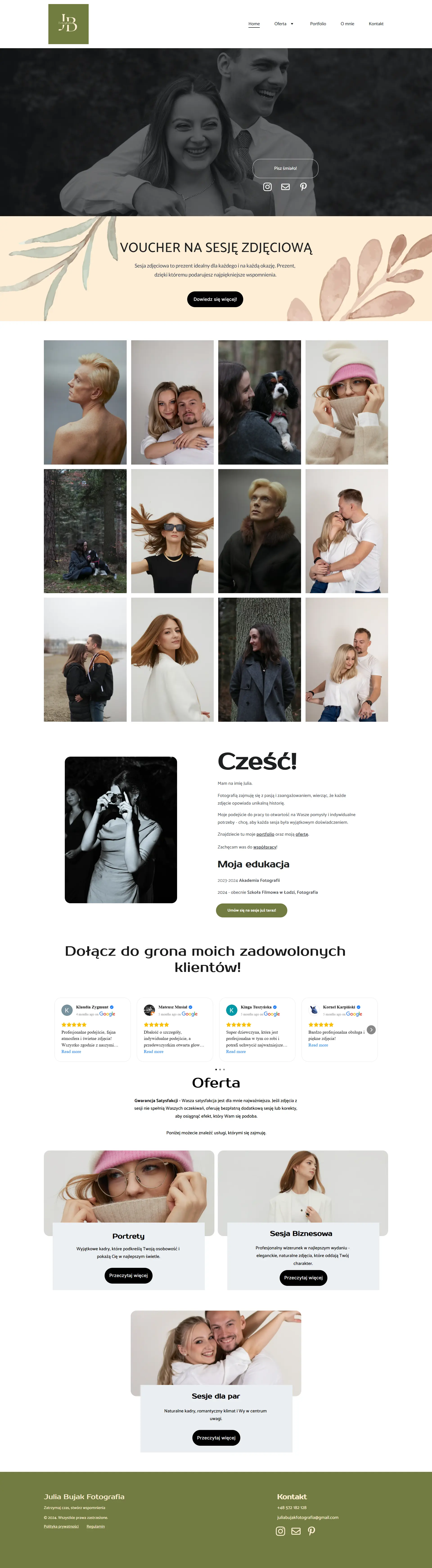 From left Julia's current website, lovable first iteration, cursor edited version, cursor made admin panel, webflow page [in progress].
Project 2 – The Fred Ops Research Hub
I'm applying for an industrial PhD and need a public lab-notebook: essays on product operations, experiment write-ups, a place for peers to comment. Unlike Julia's portfolio, this site is text-heavy and should evolve into a knowledge base.
Researching the stack (with a little help from ChatGPT)
I fed ChatGPT prompts like:
- "Cheapest blogging platforms with native SEO and easy export"
- "Ghost Pro vs Webflow CMS for technical blogging"
The pattern was clear: Ghost (Pro) kept surfacing with glowing notes on performance, portability and cost.
Why Ghost (Pro) Won
The product-ops lens told me to remove every excuse not to write. Ghost gives me a minimalist editor, SEO baked in, and a friction-free exit door if needs change-exactly what an MVP for research notes should be.
Five Product-Ops Principles in Action
- Ship to learn. Lovable proved a landing page could exist; the pivot to Cursor proved CMS mattered; Webflow proved total fit.
- Identify constraints early. Missing CMS, missing form handler-each constraint surfaced only after the previous one was solved.
- Let cost guide risk, not vision. Paying for Webflow made sense once revenue tracking mattered; paying for Ghost made sense once daily writing mattered.
- Automate discovery. ChatGPT deep searches shortened my tool-selection cycle from days to minutes.
- Keep migration cheap. Whether it's Webflow's export or Ghost's JSON backup, an easy exit is strategic insurance.
Wrapping Up
Both sites now serve their owners' core goals:
- Julia gets a conversion-optimized portfolio she can update solo.
- I get a distraction-free hub to test whether the market cares about my product-ops research.
The route looked messy-three platforms for one tiny portfolio!-but each step was an intentional experiment. That's product operations: iterate, measure, and pivot with zero shame.
If you're standing at a similar crossroads, ask yourself:
- What's my day-one "aha" moment?
- Which tool gets me there in hours, not weeks?
- How will I know it's time to pivot?
Answer those, and the next right tool usually reveals itself-just like Lovable handed the baton to Cursor, and Cursor to Webflow.
Thanks for following the journey. Subscribe for more behind-the-scenes experiments, and ping me if you're wrestling with your own tool selection-there's always another twist to share.