 Fryderyk Pryjma
Software Is Knowledge Transfer First, Code Second
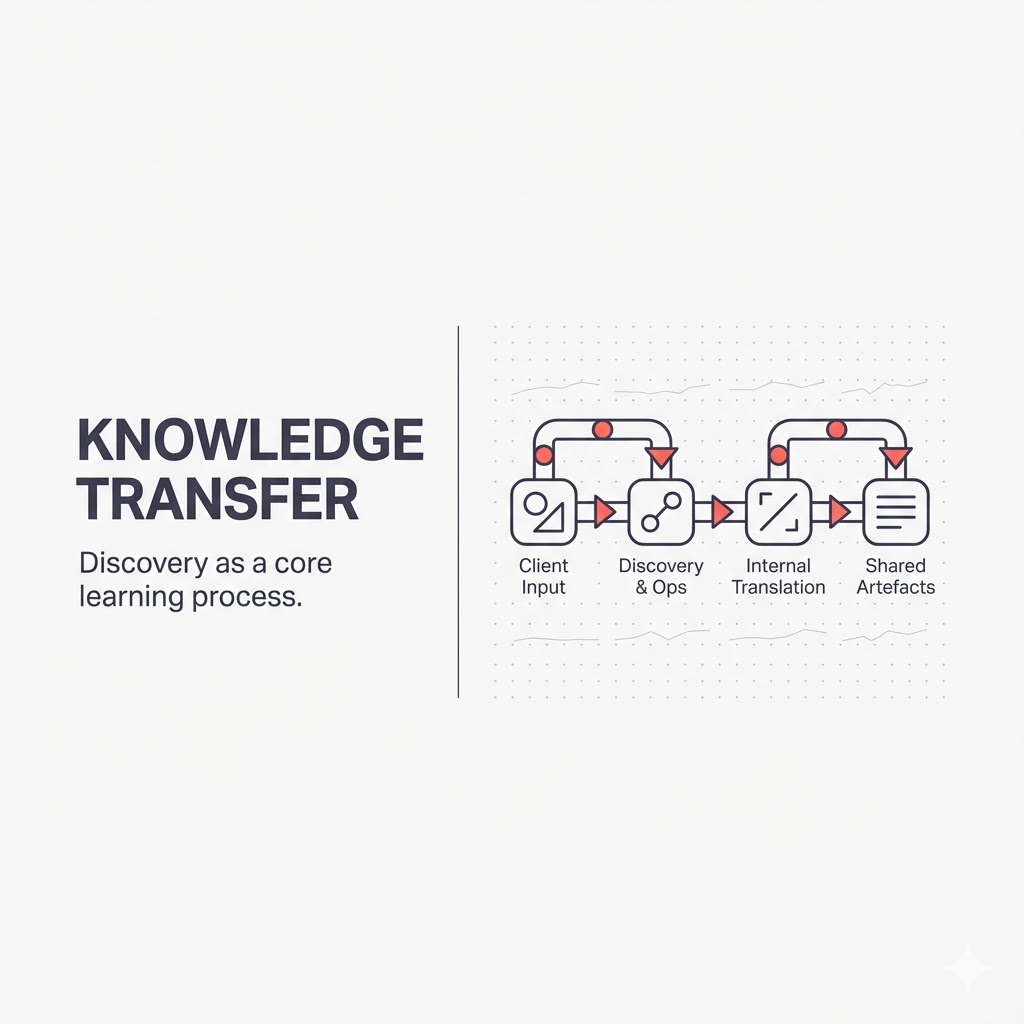
Most teams talk about software delivery as if it starts with code. It does not. Long before the first commit, a project is a chain of interpretations: what the client wants, what they actually need, what you heard, and what you passed on to the team. That chain is knowledge transfer, and it decides more about the outcome than any framework or tech stack.
This is the core idea behind how I work: value in software is created or lost in knowledge transfer, not in code. Get the handovers right and delivery gets easier. Get them wrong and no amount of engineering rescues the project.
What does "software is knowledge transfer first" mean?
It means the real work of the early phase is moving understanding between people, not producing artifacts. Requirements, estimates, and specifications are only as good as the knowledge that went into them. A vague estimate with an oversized risk buffer is not really a project risk. It is a signal that the knowledge transfer was shallow.
Where does knowledge leak in a software project?
Knowledge leaks at handovers. Every time understanding passes from one person to another, meaning can be lost. By the time a requirement reaches a tech lead, it is often third hand. The common leak points are:
- Client to consultant, during discovery and sales.
- Consultant to delivery team, in the offer and the kickoff.
- Designer to engineer, at handoff.
- Team to future team, when people leave or onboard.
Awareness of that chain is half the job. When a project starts to drift, the useful question is not "where did the plan fail" but "at which handover did the knowledge get lost".
Explicit vs tacit knowledge: what your client is not telling you
Explicit knowledge is easy to capture: scope, modules, integrations. Tacit knowledge is the part that rarely gets written down: why a decision was made, the story behind a constraint, the fears a stakeholder keeps repeating. Most failed handovers lose the tacit layer. Good discovery is largely a hunt for it.
The handover map: a simple diagnostic
You can audit a struggling project by mapping its handovers. List each point where knowledge changes hands, mark what was explicit and what was tacit, and find where the tacit part disappeared. That map usually points straight at the root cause, and it is far more useful than another status meeting.
How do you make knowledge transfer part of delivery?
- Treat the offer as a shared mental model, not a sales document. It is the first stable understanding shared by two organizations.
- When you do not know enough to estimate responsibly, run discovery as a paid deliverable. It is the first and cheapest iteration of the product.
- Capture tacit knowledge in short, structured conversations, then promote what survives review into a living knowledge base. Capture comes before retrieval.
- Keep a handover checklist so context never depends on one person's memory.
As a 2017 study of IT projects put it, "communication is the most significant factor for success in IT projects" (Stevenson and Starkweather, 2017). Knowledge transfer is that factor, made concrete.
If your team keeps losing context between discovery, design, and delivery, that is a knowledge transfer problem, not a talent problem. See how I approach the research and discovery side in Research Operations, or read more in knowledge transfer in software development discovery.
From building private AI for regulated organizations, I keep seeing the same truth: the model matters less than whether the knowledge feeding it was captured and transferred well.
Get the DesignOps Maturity Self-Assessment
A short PDF to help you spot bottlenecks in your design process.